


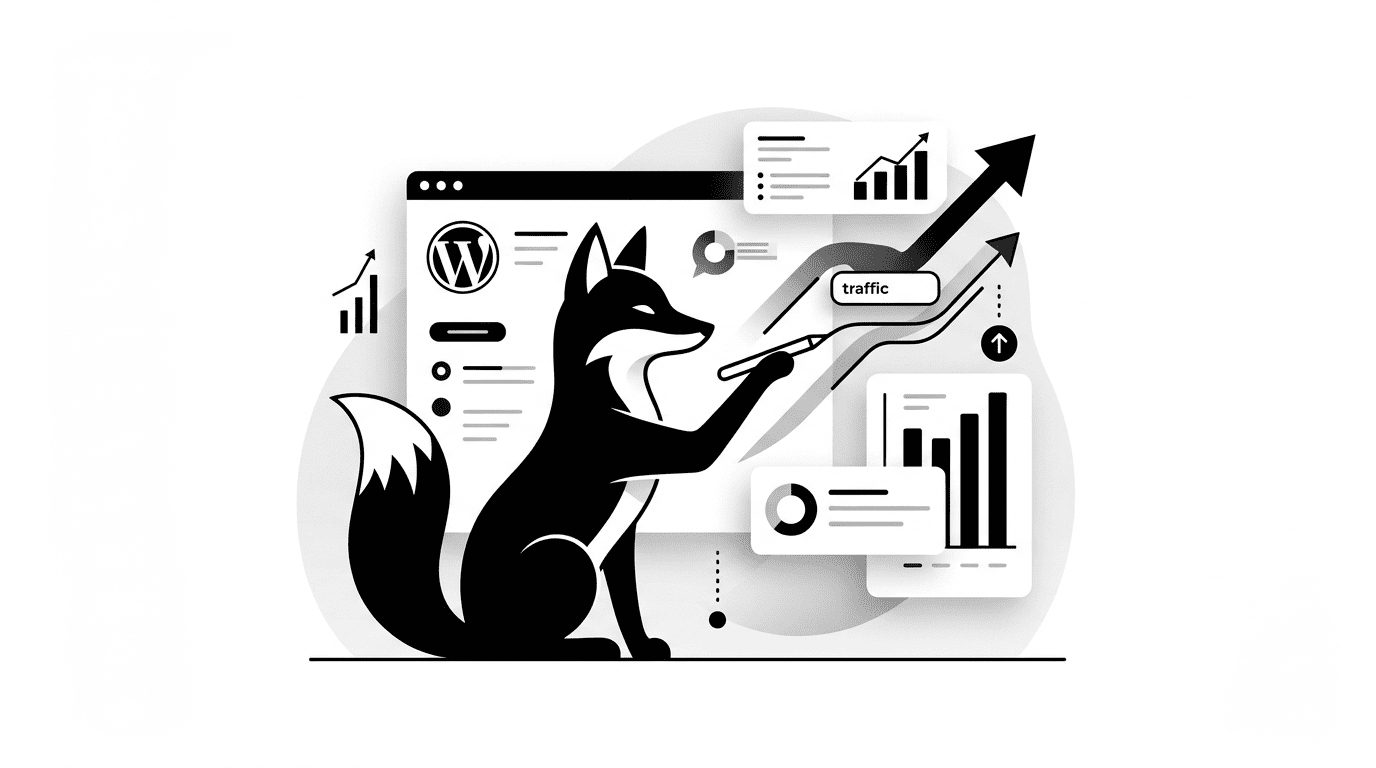
Ranking on the first page of Google is never an accident—it is the result of a calculated, ruthless strategy.
If your WordPress website is struggling to get traffic, producing more random content isn’t the answer. You need to apply proven SEO techniques that actually signal authority to search engines.
In this guide, I will reveal 10 organic SEO tactics that high-end agencies use to rank websites faster and capture highly targeted traffic.
Why SEO Actually Takes Time
Google does not hand out first-page rankings to brand new websites overnight. You have to survive the “Sandbox” phase and prove your worth.
- New domains start with zero trust and low topical authority
- Google needs to see a consistent, reliable publishing schedule
- Earning high-quality backlinks to validate your expertise takes time
TRICK 1 — Build a Ruthless Internal Linking System
Internal links are the invisible wires that pass SEO authority from one page to another. Do not leave them to chance.
- Aggressively link your related blog posts together
- Use exact-match anchor text to tell Google exactly what the target page is about
- Always go back to older, high-ranking posts to add links to your newest content
TRICK 2 — Target Hyper-Specific Long-Tail Keywords
Stop trying to rank for highly competitive, one-word keywords. Instead, target highly specific questions that your exact audience is actively searching for.
Examples of high-converting long-tail keywords:
- “how to fix wordpress 502 error on docker containers”
- “how to configure nginx caching for wordpress vps”
- “the ultimate rank math seo setup guide for beginners”
TRICK 3 — Deploy the Content Cluster Strategy
Google rewards websites that show deep expertise in one specific area. Group your content into highly focused “Silos” or topic clusters:
- The Troubleshooting Cluster (Fixing 404s, 502s, and database errors)
- The Performance Cluster (Speed optimization, CDN setups, caching)
- The SEO Cluster (On-page ranking tactics, keyword research)
TRICK 4 — Force Indexing via Google Search Console
Do not just hit publish and wait for Google to eventually find your new post. Force them to crawl it immediately.
- Paste your new URL into the Search Console inspection tool
- Manually click “Request Indexing” the second your post goes live
- Ensure your XML sitemap is actively submitted and free of errors
TRICK 5 — Engineer a High Click-Through Rate (CTR)
If Google ranks you #3, but users click your link more than the #1 result, Google will eventually move you up. Optimize your titles for human psychology.
- Use odd numbers in listicles (e.g., 7 Tips, 11 Steps)
- Inject emotional power words (Ultimate, Proven, Fix, Secret)
- Always append the current year to show the content is fresh (e.g., 2026)
TRICK 6 — Fight Content Decay by Updating Old Posts
Google heavily favors freshly updated content. If a post is over a year old, it is slowly losing its rank to “Content Decay.”
- Audit and rewrite your top-performing blog posts every 6 to 12 months
- Inject new, relevant internal links pointing to your recent articles
- Expand thin sections to make the guide much more comprehensive
TRICK 7 — Pass the Core Web Vitals Test
Google’s algorithm directly punishes slow websites. Your page speed is a confirmed, critical ranking factor.
- Deploy an aggressive caching plugin (like WP Rocket or LiteSpeed)
- Serve all images in lightweight, next-gen formats like WebP
- Route all global traffic through an enterprise CDN like Cloudflare
TRICK 8 — Enforce Strict Heading Hierarchies
Search engine crawlers read your headings like a textbook outline. If your structure is messy, Google will get confused about your topic.
- Only use exactly one H1 tag per page (Your main title)
- Use H2 tags for your primary sections and major concepts
- Nest H3 tags properly underneath your H2s for smaller, supporting details
TRICK 9 — Optimize Your Image SEO Data
Google cannot visually “see” images—it reads the raw data attached to them. Do not upload images named IMG_9942.jpg.
- Rename files to be highly descriptive (e.g.,
wordpress-502-error-fix.webp) - Write descriptive ALT text that naturally includes your target keyword
- Strip out heavy EXIF data and compress files before uploading
TRICK 10 — Commit to Algorithmic Consistency
Search engines crawl websites that publish frequently more often. Consistency is the ultimate growth hack.
- Commit to a strict publishing schedule (e.g., 2–3 high-quality articles per week)
- Stay strictly within your niche to build unshakeable topical authority
- Never sacrifice content quality just to hit an arbitrary deadline
The Final Result
- Rapidly accelerating Google search rankings
- A compounding, predictable stream of organic traffic
- Massive topical authority that dominates your niche competitors
- A long-term, highly profitable digital asset
Keep Scaling Your Traffic
- Proven strategies to drastically increase your WordPress traffic
- The ultimate WordPress SEO setup guide for absolute beginners
- How to permanently speed up your WordPress website
- The ultimate guide to securing your WordPress site from hackers
✔ Apply these exact SEO tactics consistently, and your WordPress website will inevitably grow into an authoritative, high-traffic asset over time.
Share: